
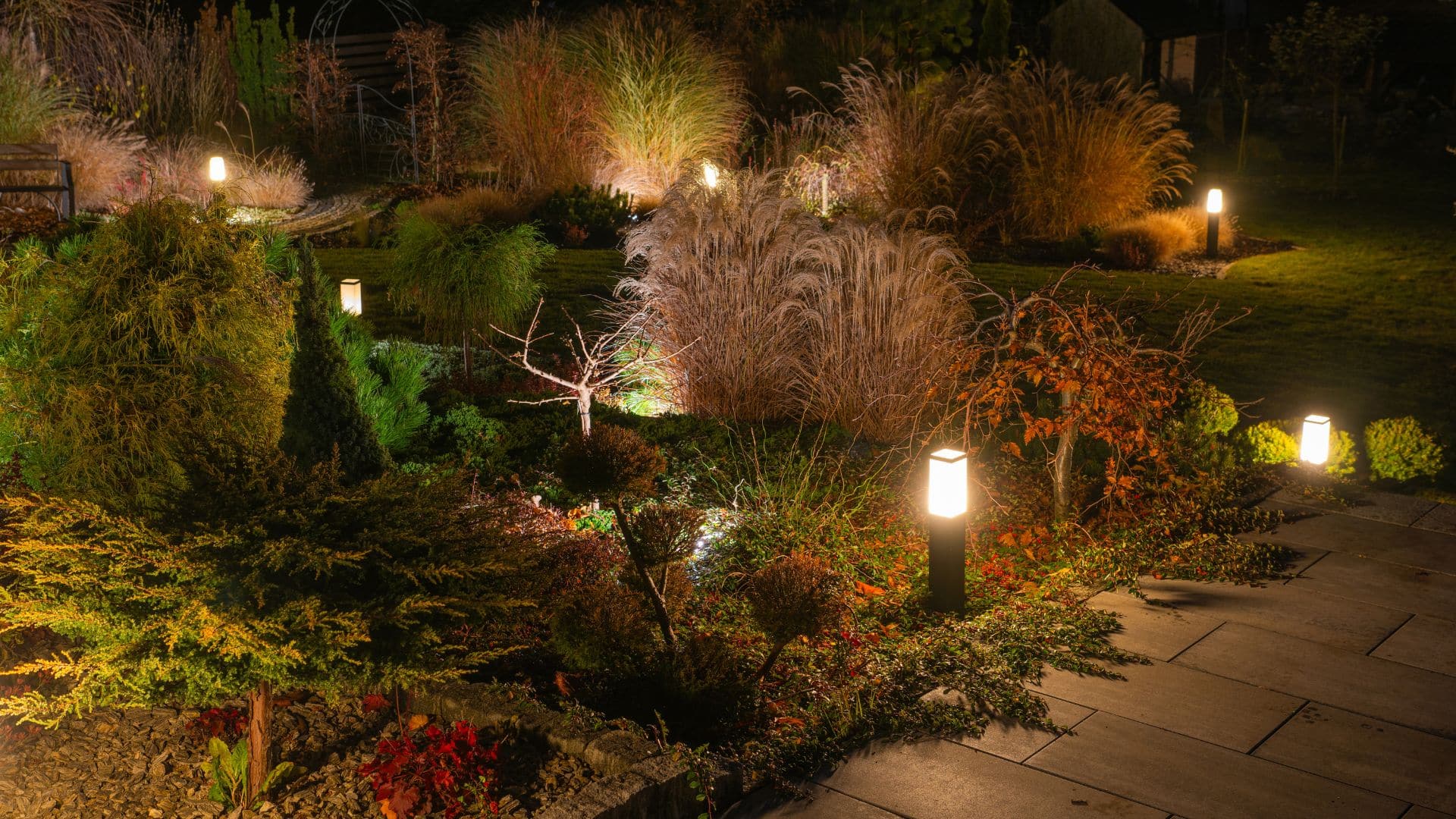
Most Michigan homeowners spend months designing and installing beautiful outdoor spaces, then watch them disappear completely the moment the sun goes down. A stunning paver patio, a carefully sculpted garden bed, a bold retaining wall that took weeks to build; all of it fades into darkness while the neighbors walk past without a second glance. It does not have to be that way, and for homeowners who have discovered what professional landscape lighting can do, there is genuinely no going back.
There is a reason landscape lighting has become one of the fastest-growing categories in residential outdoor improvement. It is the finishing layer that ties a yard together, the detail that makes a property look intentional and polished long after sunset. Whether you are entertaining guests on a Friday night, pulling into your driveway after a long day, or simply sitting on your back patio after the kids are in bed, the right lighting system changes the way your outdoor space feels entirely.
This guide covers exactly how landscape lighting works, what types of fixtures belong where, why the investment makes financial sense, and what to look for when choosing a professional to design and install your system.
How Landscape Lighting Transforms Your Outdoor Space
Landscape lighting transforms your outdoor space by extending its usability into the evening hours while highlighting the architectural and natural features that make your property unique. A well-designed system creates depth, dimension, and atmosphere that daylight simply cannot replicate, turning an ordinary yard into a space that looks and feels like it belongs in a design portfolio.
Why Darkness Is a Design Problem Worth Solving
Think about the last time you drove through a neighborhood at night and one house caught your attention. Chances are it was not the biggest house or the most expensive; it was the one that was lit well. Uplighting on a mature tree, a softly illuminated walkway, warm light washing across a stone facade; these details create an impression that sticks. That impression is exactly what professional landscape lighting delivers for your property, night after night.
In Michigan, where outdoor living is compressed into a relatively short warm season, maximizing the hours you actually spend outside matters more than it might in warmer climates. Landscape lighting effectively extends your outdoor season by making patios, fire pit areas, and pool surrounds fully functional after dark. A backyard that is only enjoyable between noon and sunset is leaving a significant portion of its potential untapped.
Beyond aesthetics and usability, there is a security dimension that deserves honest acknowledgment. A well-lit exterior reduces the opportunity for theft and vandalism by eliminating the dark corners and shadowed entry points that make a property an easier target. Motion-activated accent and pathway lighting adds a layer of deterrence that security cameras alone cannot replicate, because visible light changes behavior in a way that a small lens mounted to a soffit does not.
The Types of Landscape Lighting and Where Each One Belongs
A professional landscape lighting design is not just a matter of staking path lights along your front walkway and calling it done. Effective systems layer multiple fixture types to create depth, guide movement, and highlight the features worth seeing. Understanding the basic categories helps you have a more productive conversation with your designer and develop a clearer picture of what your finished system will look like.
| Fixture Type | Primary Use | Best Placement |
| Uplighting | Highlights trees, walls, and architectural features | Base of specimen trees, exterior walls, columns |
| Path Lights | Illuminates walkways and garden borders safely | Along driveways, walkways, and garden bed edges |
| Downlighting | Creates moonlight effect, lights seating areas | Mounted high in trees or on structures overhead |
| Spotlights | Focuses light on a single feature or plant | Sculptures, focal plantings, water features |
| Step and Wall Lights | Prevents trips, adds subtle ambient glow | Retaining walls, stairs, raised patio edges |
| Underwater Lights | Illuminates pools and water features from within | Fiberglass pool interiors, fountains, ponds |
The most effective landscape lighting designs use at least three of these fixture types in combination. A yard lit exclusively with path lights looks flat and utilitarian. A yard that layers uplighting on key trees with path lighting on the walkway and step lights on the patio edges looks like it was designed by someone who understood that outdoor lighting is as much about shadow and contrast as it is about brightness.
What Professional Landscape Lighting Does for Your Property Value
It would be difficult to have an honest conversation about landscape lighting without addressing the financial case, because the numbers are genuinely compelling. According to the National Association of Realtors, landscape lighting can add approximately $2,500 to a home’s appraised value and delivers an average return on investment of around 59 percent, making it one of the more efficient exterior improvements a homeowner can make relative to its upfront cost. You can review the full NAR data on outdoor improvements here.
That return reflects something real estate professionals have understood for years: buyers respond emotionally to a property before they respond analytically. A home that glows warmly in listing photos and looks inviting at a twilight showing triggers a different reaction than a home that disappears into the dark after 8 PM. Landscape lighting is a relatively modest investment that disproportionately affects the first impression a property makes.
For Michigan homeowners who are not planning to sell anytime soon, the value case is still strong. Energy-efficient LED landscape lighting systems use a fraction of the electricity of older halogen systems and are engineered to run for tens of thousands of hours with minimal maintenance. The cost to operate a professionally installed LED landscape lighting system for an entire evening is typically comparable to running a few standard household light bulbs, which means the nightly enjoyment comes at a very manageable ongoing cost.
How Landscape Lighting Works With Your Existing Hardscape and Landscaping
One of the most underappreciated aspects of landscape lighting is how dramatically it changes the way your existing outdoor features read at night. A paver patio that looks attractive during the day takes on an entirely different character when it is illuminated from below the retaining wall cap beside it, with warm light washing across the textured surface and casting subtle shadows between the joints. The same goes for boulder walls, Unilock features, and raised garden beds; elements that blend into the background during daylight become focal points after dark with the right lighting strategy.
Water features and fiberglass pools benefit enormously from thoughtfully placed landscape lighting. Underwater LED fixtures turn a pool into a glowing centerpiece at night, while perimeter lighting around the deck and coping extends the time the space is actually usable. For Michigan homeowners who invest in a full backyard build, skipping the lighting component is the equivalent of finishing a room and leaving out the lamps; the bones are there but the space never fully comes alive.
Trees and specimen plantings are among the most impactful targets for uplighting in a Michigan yard. A mature oak or ornamental maple that provides shade and structure during the day becomes a dramatic focal point when a well-placed uplight throws its canopy into relief against the night sky. This technique, sometimes called moonlighting when the fixture is placed high in the canopy to cast light downward, creates a natural, layered effect that is difficult to achieve with any other landscape element.
Smart Lighting Controls and Modern System Options
The technology behind landscape lighting has advanced considerably over the past decade, and modern systems offer a level of control and flexibility that older timer-based setups simply could not match. Low-voltage LED systems are now the standard for professional installations, offering color temperature options that range from warm and amber-toned to crisp and neutral, along with dimming capability that lets you adjust the mood of your outdoor space from an app on your phone.
Automated controls allow your landscape lighting system to respond to sunset and sunrise times rather than running on a fixed schedule that drifts out of sync with the seasons. This matters in Michigan, where the gap between a late June sunset and a late November sunset is substantial. A system that automatically adjusts to actual daylight conditions means your property is lit correctly every single night without any manual adjustment required.
Zone-based controls let you run different areas of your yard on independent schedules and brightness levels, so the front entry path lights that greet you every evening can run on a different program than the back patio accent lighting you use only when entertaining. This kind of flexibility makes the system genuinely useful rather than simply decorative, and it ensures you are only running the lights you actually need at any given time.
What to Look for in a Professional Landscape Lighting Installer
Installing landscape lighting correctly involves more than pushing stakes into the ground and connecting wire. A professional installer will assess your existing landscaping, identify the key features worth highlighting, design a layered system that accounts for how your yard is actually used, and install everything in a way that is safe, weatherproof, and maintainable. The difference between a professionally designed system and a DIY approach is almost always visible from the street.
Ask any installer you are considering whether they use low-voltage LED fixtures specifically, whether the wire connections are waterproofed correctly for underground installation, and whether the transformer they are recommending is properly sized for the total wattage of the system. Undersized transformers are one of the most common causes of premature landscape lighting failure, and it is a detail that separates contractors who understand the technical side of the work from those who are simply following a template.
Look for a company that integrates landscape lighting into the broader context of your outdoor design rather than treating it as a standalone add-on. A contractor who understands your paver layout, your plant selections, and the architectural features of your home will design a lighting system that feels like it belongs rather than one that was installed after the fact. That integration is what elevates landscape lighting from a practical upgrade to a genuine design statement.
Let Horizon Landscape Bring Your Yard to Life After Dark
If your outdoor space goes dark every evening and you have been thinking about changing that, there has never been a better time to explore what professional landscape lighting can do. The team at Horizon Landscape designs and installs lighting systems that work in harmony with your existing hardscape, landscaping, and pool areas to create an outdoor environment that looks as good at 9 PM as it does at noon.
Your yard deserves to be seen, even after the sun goes down. Contact Horizon Landscape Inc. today to schedule a consultation and start designing the outdoor lighting system your property has been missing.
Frequently Asked Questions
How much does professional landscape lighting cost for a Michigan home?
The cost of a professionally installed landscape lighting system in Michigan typically ranges from $2,500 to $8,000 or more depending on the size of the property, the number of fixtures, and the complexity of the design. Smaller systems focused on a front entry and walkway will fall toward the lower end of that range, while full-property systems covering the backyard, pool area, and garden beds will sit higher. Most homeowners find the investment pays for itself quickly through improved property value and extended outdoor usability.
What type of landscape lighting is best for Michigan winters?
Low-voltage LED fixtures made from brass, copper, or high-grade aluminum are the most durable choices for Michigan’s climate. These materials resist corrosion and hold up well through freeze-thaw cycles that can crack or degrade lower-quality plastic fixtures over time. LED bulbs themselves are highly cold-tolerant and actually perform better in cold temperatures than incandescent options, making them an ideal fit for year-round use in Michigan conditions.
Can landscape lighting be added to an existing yard or does it need to be installed during construction?
Landscape lighting can absolutely be added to an existing yard and in many cases requires minimal disruption to do so. Low-voltage wire is thin enough to be buried shallowly along bed edges and under mulch without major excavation. A professional installer can typically work around mature plantings, existing pavers, and established lawn areas with very little visible evidence of the installation once the work is complete.
How long do LED landscape lighting fixtures last?
Quality LED landscape lighting fixtures are rated for 30,000 to 50,000 hours of operation, which translates to decades of use at typical runtime schedules. The LED components themselves rarely fail; when landscape lighting systems require service it is usually for reasons like connection corrosion, damaged wire from landscaping activity, or transformer issues rather than burned-out bulbs. Choosing a professional-grade system from the start significantly reduces the likelihood of early maintenance issues.
Does landscape lighting deter crime and improve home security?
Yes, a well-lit exterior meaningfully reduces the opportunity for theft and vandalism by eliminating the dark areas around entry points, gates, and ground-level windows that are most commonly exploited. Motion-activated fixtures are particularly effective because the sudden change in lighting draws attention and signals that a space is monitored. Research from the Lighting Research Center indicates that proper outdoor lighting can reduce crime rates by up to 39 percent, making it one of the more impactful passive security measures available to homeowners.
What is the difference between low-voltage and line-voltage landscape lighting?
Low-voltage systems operate at 12 volts and use a transformer to step down standard household current, making them safe to install, energy-efficient to operate, and easy to modify or expand over time. Line-voltage systems run at full 120 volts and require a licensed electrician for installation due to the higher shock and fire risk involved. For residential landscape lighting, low-voltage LED systems are the professional standard and the choice virtually every reputable installer will recommend for outdoor applications.
Horizon Landscape Inc. proudly serves Hartland, MI. Questions about landscape lighting or any of our outdoor design services? Contact our team today.