
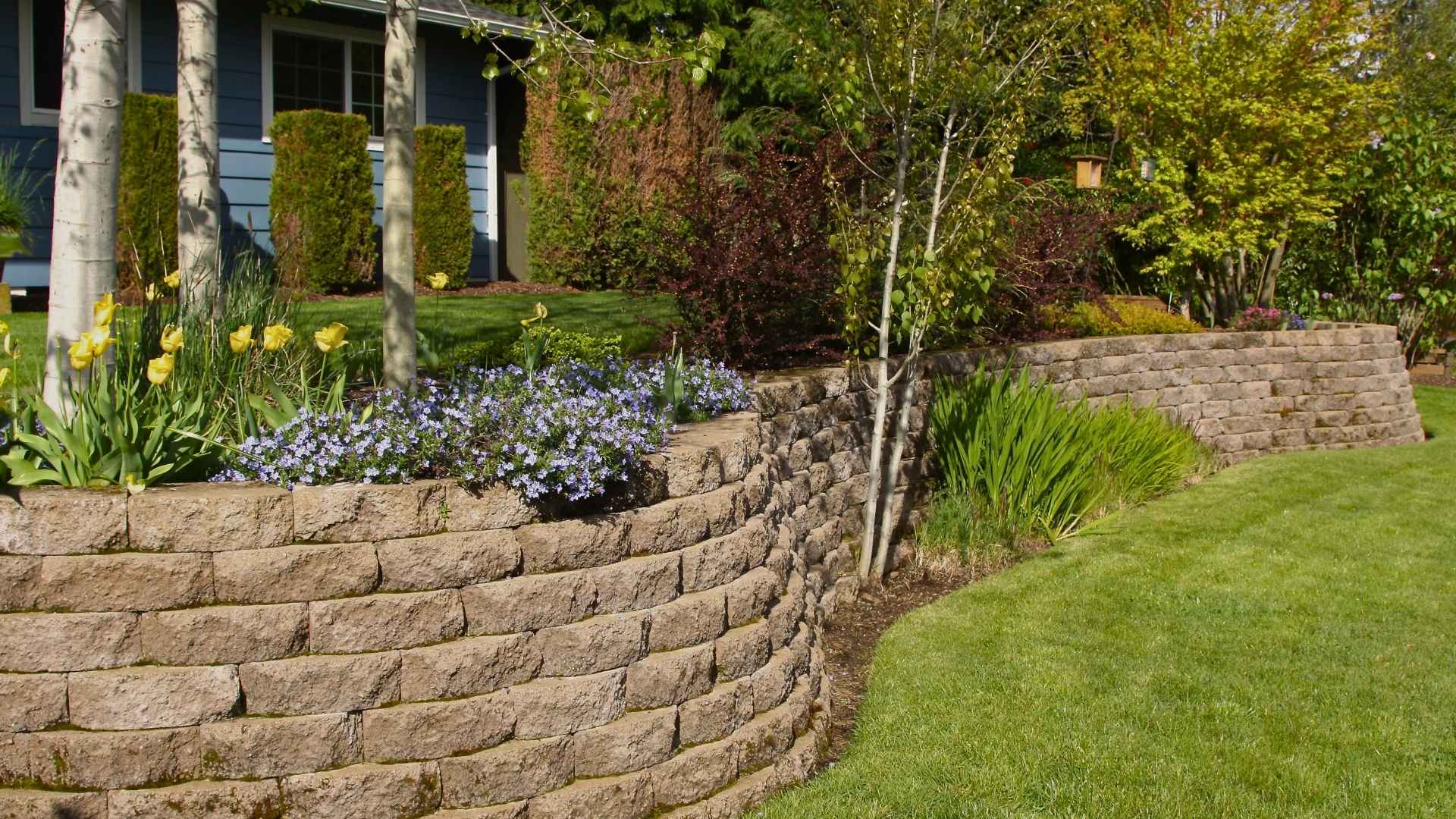
If water pools in your yard after every rainstorm, or you have watched soil slowly disappear from your garden beds and slopes season after season, you are dealing with a problem that does not fix itself. Drainage issues and erosion are two of the most common and most damaging challenges homeowners face, and they tend to get worse over time if left unaddressed. The good news is that there is a proven, long-lasting solution sitting right at the intersection of function and beauty: the retaining wall.
A well-designed and properly installed retaining wall does far more than hold back dirt. It redirects water, stabilizes slopes, protects your foundation, and gives your landscape a defined structure that adds real value to your property. Whether your yard has a gentle grade or a serious drop in elevation, a retaining wall can transform a frustrating drainage headache into a clean, organized outdoor space that actually works with your land instead of against it.
This article breaks down exactly how retaining walls address drainage and erosion at the source, what causes these problems in the first place, and what you should consider before investing in a solution that will stand up for decades.
Why Yards Are So Prone to Erosion and Drainage Problems
Climate is uniquely challenging for residential landscapes. The combination of heavy spring rainfall, rapid snowmelt, and clay-heavy soil found across much of the state creates conditions where water has nowhere productive to go. When the ground cannot absorb water fast enough, it travels across the surface, picking up topsoil, mulch, and nutrients as it moves. That process is erosion, and even a modest slope can lose several inches of topsoil per year under the right conditions.
Clay soil compounds the problem significantly. Unlike sandy or loamy soils that absorb water relatively quickly, clay soil is dense and slow to drain. Water sits on top of or just beneath the surface for extended periods, saturating plant roots, creating muddy low spots, and putting hydrostatic pressure on any structure in its path, including your home’s foundation and basement walls. For homeowners on sloped or tiered lots, that pressure builds up season after season.
The freeze-thaw cycle defines that winters add another layer of stress to already compromised landscapes. Water that has saturated the soil freezes and expands, shifting soil and disrupting grades that took years to establish. By the time spring arrives, what once looked like a manageable slope can suddenly look like a lumpy, eroding mess with ruts, bare patches, and pooling water in all the wrong places.
Understanding why these problems happen is the first step toward solving them effectively. Throwing seed and mulch at an erosion problem without addressing the underlying water movement is the landscaping equivalent of bailing out a boat without finding the leak. A retaining wall addresses the root cause by controlling how and where water flows through your property.
How a Retaining Wall Controls Water Movement
The core function of a retaining wall in a drainage context is to interrupt the path of water traveling downhill across your property. When a slope is left uninterrupted, water accelerates as it descends, gaining enough velocity to carry soil with it. A retaining wall breaks that slope into level tiers, slowing water down and giving it time to absorb into the ground rather than racing across the surface and taking your topsoil with it.
Properly built retaining walls incorporate drainage systems within their structure to manage the water they collect. Gravel backfill placed directly behind the wall allows water to filter through rather than building up pressure against the face of the wall. Many installations also include a perforated drainage pipe at the base of the wall that channels collected water away from the structure and toward a safe outlet. Without these drainage components, even a beautifully constructed retaining wall can fail prematurely due to hydrostatic pressure buildup.
According to the Environmental Protection Agency, unmanaged stormwater runoff is one of the leading causes of residential landscape degradation in the Midwest, contributing to topsoil loss, foundation damage, and water quality issues in local waterways. A retaining wall that incorporates proper drainage engineering directly addresses this problem at the property level, protecting both your landscape investment and the surrounding environment.
The terracing effect created by a retaining wall system also improves soil health over time. By holding topsoil in place on level planting beds, retaining walls allow organic matter to accumulate rather than wash away. Plants establish deeper root systems, water retention improves, and the soil becomes progressively more productive year over year. What starts as an erosion fix gradually becomes a foundation for a thriving landscape.
The Real Cost of Ignoring Erosion on Your Property
It is easy to look at a slightly eroding slope and decide to deal with it next season. The problem is that erosion compounds. A small rill that forms in your lawn this spring becomes a deeper channel by fall, and a deeper channel by next spring becomes a gully that no amount of seeding will repair without significant earthwork. The longer erosion goes unaddressed, the more expensive the eventual fix becomes.
Foundation damage is the most serious downstream consequence of unmanaged drainage. When water consistently flows toward your home rather than away from it, it saturates the soil around your foundation, increases hydrostatic pressure against basement walls, and can eventually lead to cracking, seepage, and structural compromise. Foundation repairs can run anywhere from $5,000 for minor crack injection to $30,000 or more for major waterproofing and structural reinforcement. A retaining wall installed before that damage occurs is a fraction of that cost.
There is also the matter of property value. Homes with visibly eroded yards, bare slopes, and persistent drainage issues consistently appraise lower than comparable properties with well-maintained landscapes. Curb appeal matters enormously in the real estate market, and a yard that looks like it has an ongoing problem signals to buyers that more issues may be lurking. A thoughtfully designed retaining wall system not only solves the functional problem but also signals to buyers and appraisers that the property has been well cared for.
Choosing the Right Retaining Wall Material for Your Yard
Not all retaining walls are built from the same material, and the right choice depends on the height of the slope you are managing, your aesthetic preferences, and your budget. Each material has its own set of strengths, and an experienced contractor will help you match the right system to the specific demands of your landscape.
Boulder retaining walls are one of the most natural-looking options available and are particularly well-suited to larger, more naturalistic landscapes. Large fieldstone or granite boulders are set in a staggered pattern that mimics the look of a natural rock outcropping while providing serious structural stability. Boulder walls handle significant soil loads well and age beautifully, developing a weathered character that blends seamlessly into natural surroundings over time.
Unilock retaining walls use engineered concrete block systems that offer precise, repeatable aesthetics with excellent structural performance. Unilock products are available in a wide range of textures and colors, making them a strong choice for homeowners who want their retaining wall to complement a broader hardscape design including patios, walkways, and driveways. The interlocking block system is engineered for long-term stability and is backed by manufacturer warranties that reflect confidence in the product’s performance.
Redi-Rock is a large-format modular block system that is particularly effective for taller walls and commercial-grade applications. Each block weighs hundreds of pounds, providing mass-based stability that performs exceptionally well under heavy soil and water loads. The scale of Redi-Rock makes it a smart choice for significant grade changes where smaller block systems would require more complex engineering. For homeowners with challenging topography, Redi-Rock offers the kind of long-term reliability that justifies the investment.
What a Professional Installation Looks Like
A professional retaining wall installation begins with a site evaluation that goes well beyond measuring the slope. Your contractor should assess soil composition, existing drainage patterns, the source of water that is contributing to your erosion problem, and any underground utilities or structures that could affect the installation. Skipping this assessment is how walls end up failing within a few years of installation, even when the materials themselves are high quality.
Excavation is followed by the preparation of a compacted gravel base that provides a level, stable foundation for the wall. The depth and width of this base layer depends on the height and weight of the wall being built, and getting it right is critical to long-term performance. A wall that looks perfect on day one but sits on an inadequate base will begin to lean, shift, and crack as the seasons cycle through.
As the wall is built upward, gravel backfill is placed and compacted in lifts behind the wall face. Drainage pipe is installed at the base of the wall where the design calls for it, and batter (the slight backward lean built into the wall) is maintained throughout construction to keep the structure stable against the soil load it is holding. These details are invisible once the job is complete, but they are what separates a wall that lasts 30 years from one that needs repair in five.
Once the wall is complete, your contractor should address the grading and planting around it to direct water away from the structure and stabilize the freshly disturbed soil. Seeding, sod, or plantings placed strategically at the top and base of the wall help lock in the gains the retaining wall has made and give the entire landscape a finished, cohesive appearance.
Signs Your Yard Is Telling You It Needs a Retaining Wall
Some yards make the need obvious. If you have a steep slope that loses mulch every time it rains, visible ruts or channels forming in your lawn, or soil that has pulled back from the base of your foundation, those are clear signals that water and erosion are actively working against your property. A retaining wall is not just a cosmetic upgrade in these situations; it is a necessary intervention.
Other signs are subtler but just as important. Leaning fence posts, tree roots that are becoming increasingly exposed, and patches of lawn that simply will not grow despite repeated seeding are all indicators of soil instability driven by water movement. These problems will not self-correct. The soil that has already left your property is gone, and the process will continue at an accelerating rate without a structural solution in place.
If your basement has shown any signs of moisture intrusion, staining on interior walls, or a musty smell that appears in wet seasons, the drainage situation in your yard may already be affecting your home’s structure. Pairing a retaining wall installation with a broader yard drainage assessment is the most proactive approach to protecting both your landscape and your home from further damage.
Let Horizon Landscape Solve Your Drainage and Erosion Problems
You do not have to keep watching your yard wash away. Our team has the expertise and the experience to assess your property, recommend the right retaining wall system for your specific needs, and install it with the craftsmanship that makes it last. From boulder walls and Unilock systems to large-format Redi-Rock installations, we bring the full range of solutions to every project we take on.
A stronger, better-draining yard is one conversation away. Contact Horizon Landscape today to schedule your site assessment and find out exactly what your yard needs to perform the way it should.